
Skincare SEO strategy
Ranking a beauty blog in 2026 isn’t about just finding the right keywords. It's a much more nuanced game. Skincare, unlike some other niches, demands a deep understanding of why someone is searching. Are they looking for a quick fix, long-term solutions, or simply information about ingredients? Searcher intent is paramount, and Google is increasingly sophisticated at recognizing it.
The visual aspect is huge. People want to see results, see products, and see how things are applied. This means your content needs to be visually appealing and informative. But beyond that, Google prioritizes expertise, authoritativeness, and trustworthiness – often called E-A-T. Because skincare touches on health and wellbeing, Google will scrutinize your content more closely than, say, a fashion blog reviewing handbags.
This isn’t a guide about keyword stuffing or quick tricks. It’s about building a sustainable SEO strategy that focuses on providing genuine value to your audience and establishing your blog as a trusted resource. You need to build a brand people recognize and believe in, and that starts with quality content and a commitment to accuracy.
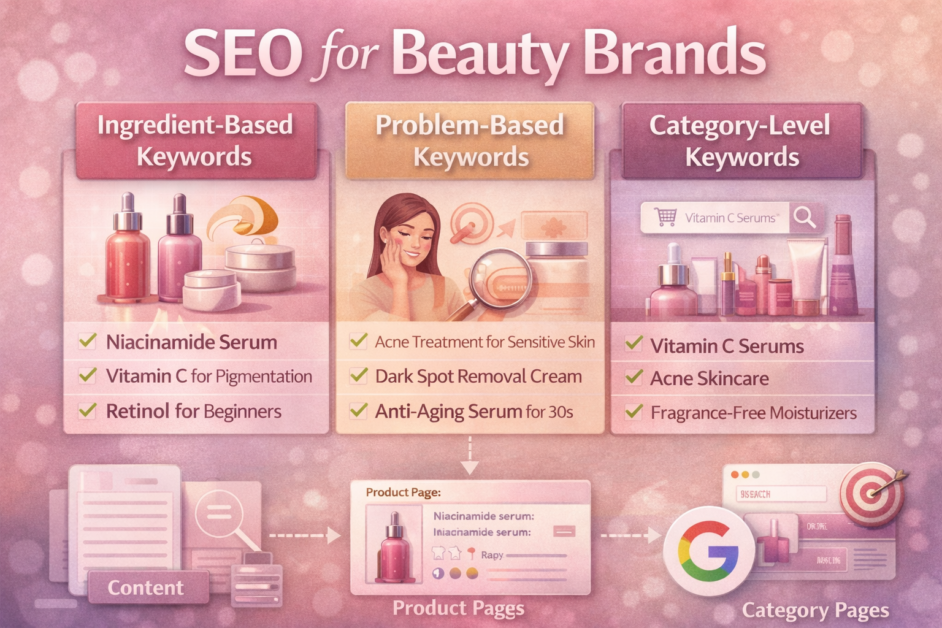
How keyword research is changing
Long-tail keywords remain important. Targeting phrases like 'best moisturizer for dry, sensitive skin in winter' will always be valuable, but the way people search is evolving. We’re seeing a significant rise in question-based queries – things like 'how to get rid of dark circles under eyes' or 'what causes hormonal acne?' Focusing on answering these questions directly in your content is key.
Tools like Ahrefs and Semrush are still incredibly useful for identifying keyword opportunities, and Google’s Keyword Planner can provide valuable data. However, don’t rely solely on these tools. Spend time on forums like Reddit (r/SkincareAddiction is a good starting point) and in Facebook groups to understand the actual language people are using and the problems they’re trying to solve. This qualitative research is often more valuable than any keyword tool.
The rise of visual search on platforms like Pinterest and Google Lens means optimizing your images with descriptive alt text is more critical than ever. Voice search is also becoming more prevalent. Think about how people phrase questions when speaking – it’s often more conversational than typed searches. Consider incorporating natural language into your content to cater to voice search queries.
Don't forget to analyze search results pages (SERPs) for your target keywords. What kind of content is already ranking? Is it listicles, how-to guides, product reviews? Understanding the competitive landscape will help you create content that stands out.
- Use Ahrefs or Semrush to find keyword ideas.
- Check r/SkincareAddiction to see the specific slang and questions readers use.
- Optimize images for visual search with detailed alt text.
- Consider conversational language for voice search.
- Analyze SERPs to understand the competition.
Keyword Research Tool Comparison for Beauty Bloggers (2026 Outlook)
| Tool | Keyword Difficulty Assessment | Search Volume Data | Related Keyword Suggestions | Overall Strengths |
|---|---|---|---|---|
| Ahrefs | Generally considered more accurate for competitive keyword difficulty | Comprehensive, large database, often cited for global data | Excellent; provides a broad range of related terms and question-based keywords | Strong all-around tool, particularly valuable for identifying competitor keywords and backlink analysis. |
| Semrush | Difficulty scores can be less conservative than Ahrefs | Robust data, with a focus on US and European markets | Very good; offers keyword variations, phrase match, and related searches | Excellent for competitive research, site audits, and tracking keyword rankings. |
| Google Keyword Planner | Difficulty assessment is limited; focuses on ad competition | Data is geared towards Google Ads; search volume presented as ranges | Good for initial brainstorming, but suggestions can be broad | Free to use with a Google Ads account; useful for understanding basic search trends and ad costs. |
| Moz Keyword Explorer | Provides a 'Difficulty' score, but may be less granular than Ahrefs/Semrush | Good data, integrates well with other Moz tools | Decent suggestions, focuses on opportunity and potential | Strong integration with Moz's suite of SEO tools, good for beginners. |
| Ubersuggest | Difficulty scores are generally lower than other tools | Data is improving, but can sometimes be less reliable than established platforms | Provides a decent number of suggestions, including content ideas | More affordable option, good for those starting out with keyword research. |
| KeywordTool.io | Does not provide a difficulty score | Leverages Google Autocomplete to generate a large volume of long-tail keywords | Exceptional for long-tail keyword research and finding niche topics | Specializes in uncovering long-tail keywords, useful for targeting very specific searches. |
Qualitative comparison based on the article research brief. Confirm current product details in the official docs before making implementation choices.
Content Pillars & Topical Authority
Instead of chasing individual keywords, focus on building topical authority. This means creating comprehensive content around core skincare topics like acne, anti-aging, sensitive skin, or hyperpigmentation. Think of these as your 'content pillars'. Each pillar should be supported by a cluster of related articles and resources.
For example, your 'acne' pillar could include articles on different types of acne, causes of acne, treatments for acne, skincare routines for acne-prone skin, and dietary changes to help manage acne. Internally linking these articles together signals to Google that your blog is an authority on the topic. A well-structured blog, with clear category pages and internal linking, is essential for supporting this strategy.
Sueann Singh, from Saidbysue.com, learned the value of consistent, focused content after reaching 100 blog posts. She emphasizes that consistent effort, even if it's slow, builds momentum and establishes your authority over time. Don’t spread yourself too thin by trying to cover every skincare topic under the sun. Focus on a few key areas and become the go-to resource for those topics.
Optimizing photos and video
Skincare is inherently visual. People want to see before-and-after photos, product textures, and application techniques. High-quality images and videos aren't simply 'nice-to-haves'; they're absolutely essential for SEO and user engagement. Poor visuals can immediately turn visitors away.
Optimize your images by using descriptive alt text that includes relevant keywords. Reduce file sizes to improve page loading speed (use tools like TinyPNG). Name your image files strategically – instead of 'IMG_2024.jpg', use 'best-moisturizer-for-dry-skin.jpg'.
Video content, particularly on platforms like YouTube, Instagram Reels, and TikTok, has huge potential. Embedding relevant videos into your blog posts can increase time on page and improve engagement. Fashion Mumblr consistently highlights the importance of high-quality visuals in attracting and retaining an audience. Repurpose video content into blog posts, and vice versa, to maximize its reach.
- Use descriptive alt text for all images.
- Compress images to reduce file size.
- Use keyword-rich image file names.
- Embed relevant videos in blog posts.
- Repurpose content across platforms.
Schema markup for rich snippets
Schema markup is code you add to your website to help search engines understand your content better. It doesn’t directly impact rankings, but it can improve your chances of appearing in rich snippets – those enhanced search results with extra information like star ratings or product prices.
For skincare blogs, relevant schema types include Product (for product reviews), Review (for individual product reviews), and Article (for blog posts). Implementing schema can be technical, and may require some coding knowledge or the use of a plugin.
Adding this code takes about ten minutes with a plugin like Yoast or RankMath, but it makes your search result stand out with star ratings and price tags.
Link Building in a Competitive Niche
Link building is notoriously difficult, especially in the competitive beauty space. Guest posting, while still an option, often yields low-quality links that don’t provide much value. Focus on earning links by creating truly exceptional content that people want to share and link to.
Consider creating linkable assets like original research (e.g., a survey about skincare habits), in-depth guides that solve a specific problem, or expert interviews with dermatologists or cosmetic chemists. Broken link building – finding broken links on other websites and offering your content as a replacement – can also be effective.
Prioritize quality over quantity. One link from a highly authoritative website is worth far more than dozens of links from low-quality sites. Building relationships with other bloggers and influencers in the skincare niche can also open up opportunities for collaboration and link exchanges.
- Publish original surveys or ingredient safety guides to earn natural backlinks.
- Conduct broken link building.
- Focus on quality links from authoritative sites.
- Build relationships with other bloggers and influencers.




No comments yet. Be the first to share your thoughts!