
The AI Blogging Shift: 2026 Realities
The world of blogging has changed dramatically. It feels like only yesterday—around 2024—that AI content creation tools first burst onto the scene, promising to revolutionize how we create online. Now, in 2026, the initial hype has settled, and we're seeing a much more mature market. These tools aren’t about replacing bloggers, but about fundamentally shifting how we work.
There was understandable anxiety early on. Concerns about authenticity, the potential for generic content flooding the internet, and even the ethical implications of AI-generated work were—and continue to be—valid. It's easy to worry about losing your unique voice in a sea of algorithmically produced text. However, the most successful bloggers are learning to harness AI’s power responsibly.
The key is understanding that AI is a tool, not a substitute for creativity and genuine connection with your audience. It's a powerful assistant, capable of handling tedious tasks and boosting productivity, but it requires a human hand to guide it and ensure the final product reflects your brand and values. The bloggers who adapt and integrate AI thoughtfully will be the ones who thrive.
We've moved past the initial 'wow' factor. The tools have become more sophisticated, more integrated, and more nuanced. They’re no longer just about spitting out text; they’re about helping you refine your ideas, optimize your content, and reach a wider audience. This article is about navigating this new reality and leveraging AI to build a more successful, and authentically you, blog.
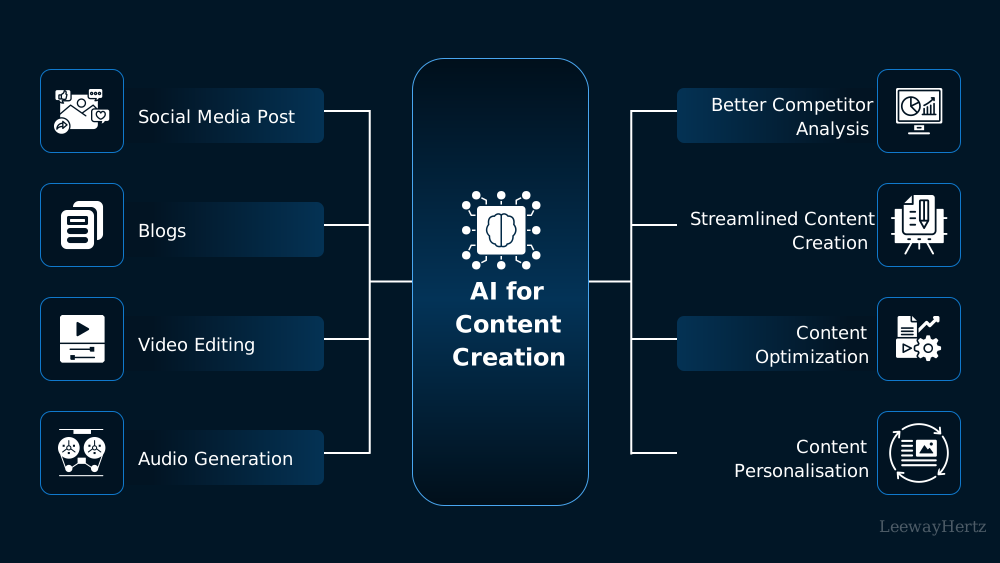
AI Tools Categorized: A 2026 Landscape
The range of AI tools available to bloggers is impressive, and it’s growing all the time. While some tools attempt to be all-in-one solutions, most specialize in specific areas. Breaking down these categories helps you identify the tools that will best address your needs.
Idea Generation tools, like RightBlogger (as discussed on YouTube by content creators), help overcome writer’s block by suggesting blog post topics based on keywords, trends, or your existing content. These tools can analyze what’s performing well in your niche and identify gaps in the market.
Content Drafting tools go a step further, actually writing sections or even entire blog posts for you. They work best when given a clear outline and specific instructions. Don’t expect a perfectly polished piece; these tools are more like a very efficient first draft generator.
SEO Optimization tools assist with keyword research, competitor analysis, and on-page optimization. They can suggest relevant keywords, analyze your content for readability, and provide recommendations for improving your search engine rankings. These are increasingly integrated into other tools, rather than existing as standalone products.
Image/Visual Creation tools, powered by AI, can generate unique images, illustrations, or even short videos to accompany your blog posts. This is especially useful if you don’t have a budget for stock photos or graphic design. These tools are becoming increasingly sophisticated, capable of creating surprisingly realistic and creative visuals.
Finally, Editing/Proofreading tools help refine your writing, correct grammar and spelling errors, and improve overall clarity. These tools are essential for ensuring your content is polished and professional. Many now offer suggestions for tone and style, helping you maintain a consistent brand voice.
AI Tool Category Comparison - 2026
| AI Tool Category | Cost | Ease of Use | Creative Control | Risk of Generic Output |
|---|---|---|---|---|
| Idea Generation | Generally Lower | High | Medium | Medium - Requires careful prompting |
| Content Drafting | Variable, can be Higher | Medium | Lower | High - Significant editing often needed |
| SEO Optimization | Medium | Medium | Medium | Low - Focuses on data, less on originality |
| Image/Visual Creation | Variable | High | Medium | Medium - Style consistency can be challenging |
| Editing/Proofreading | Generally Lower | High | High | Low - Primarily focused on mechanics |
Qualitative comparison based on the article research brief. Confirm current product details in the official docs before making implementation choices.
The Top 7 AI Assistants for Bloggers
Choosing the right AI tools can feel overwhelming. Here are seven options that consistently rank highly among bloggers in 2026, along with a breakdown of their strengths, weaknesses, and ideal users.
1. Jasper: Jasper remains a popular choice for long-form content creation. It excels at writing blog posts, articles, and even marketing copy. Key features include its "Boss Mode’ which allows for more control over the AI"s output, and its integration with Surfer SEO. Jasper is best for bloggers who need to produce a high volume of content quickly, but it can be expensive. Potential drawbacks include a tendency to produce somewhat generic content if not carefully prompted.
2. Scalenut: Scalenut focuses on SEO-driven content. It’s particularly strong at keyword research and creating content briefs. The platform helps you identify topics with high search volume and low competition, and then guides you through the writing process. Scalenut is ideal for bloggers who are serious about SEO and want to improve their search engine rankings. It's a good option for more technical bloggers.
3. Rytr: Rytr is a more affordable option, making it a great choice for beginner bloggers or those on a tight budget. It offers a variety of writing templates and supports multiple languages. While it may not be as powerful as Jasper or Scalenut, it’s still a capable tool for generating short-form content, social media captions, and blog post ideas. It's a good starting point.
4. Copy.ai: Copy.ai is known for its ease of use and its focus on marketing copy. It’s particularly good at generating headlines, product descriptions, and ad copy. While it can also be used for blog posts, it’s best suited for bloggers who need help with their marketing efforts. The interface is very intuitive.
5. Surfer SEO (with AI add-ons): While traditionally an SEO tool, Surfer SEO has integrated AI features that help with content creation. It analyzes top-ranking content for your target keywords and provides data-driven insights to help you write better content. It’s best for bloggers who want to optimize their content for search engines. It’s less about writing the content and more about optimizing it.
6. RightBlogger: As highlighted on YouTube, RightBlogger offers a unique approach. It's a more focused AI assistant, designed to streamline the content creation process. It's particularly helpful for research and idea generation, offering a solid foundation for building out full blog posts. The platform is known for its simplicity and affordability.
7. GrammarlyGO: Grammarly’s AI writing assistant, GrammarlyGO, is seamlessly integrated into the Grammarly platform. It’s excellent for refining existing content, improving clarity, and ensuring grammatical accuracy. It’s a valuable tool for any blogger, regardless of their experience level. It's less about generating new content, and more about perfecting your existing work.
Authenticity Checks: Guarding Your Voice
Using AI doesn't mean sacrificing your unique voice and perspective. In fact, it's more important than ever to maintain authenticity in a world increasingly saturated with AI-generated content. The goal isn't to have AI write for you, but to have it assist you.
Heavily editing AI-generated content is non-negotiable. Treat it as a first draft, not a finished product. Inject your own personality, anecdotes, and insights into the text. Don't be afraid to rewrite entire sections to ensure they align with your brand voice.
Focus on using AI for tasks that free up your time and energy, such as research, outlining, and generating initial ideas. Let AI handle the tedious parts of the process, and then focus your creativity on the aspects that require a human touch. Using it as a starting point, not the endpoint, is key.
Plagiarism is a serious concern. Always run AI-generated content through a plagiarism checker like Copyscape or Quetext before publishing. While AI tools are designed to generate original content, they can sometimes inadvertently produce text that is similar to existing sources. A quick check can save you from potential legal issues and reputational damage.
Think of your brand voice as a core element of your blog. AI can help you maintain that voice by suggesting phrasing and tone, but it can’t create it. Your unique perspective and experiences are what set you apart from the competition.
- Edit rigorously: Treat AI output as a draft.
- Inject personality: Add anecdotes and insights.
- Focus on high-level tasks: Use AI for research and outlines.
- Check for plagiarism: Always verify originality.
- Maintain your brand voice: Ensure consistency.
SEO in the Age of AI: What’s Changed?
AI has significantly impacted the SEO landscape. While the fundamentals of SEO—keyword research, link building, and content quality—remain important, the way we approach these tasks has evolved. Google's algorithms are becoming increasingly sophisticated at detecting AI-generated content, and they prioritize content that is genuinely helpful and informative.
Keyword research is still crucial, but it’s no longer enough to simply stuff your content with keywords. Focus on understanding user intent and creating content that answers their questions. AI tools can help with keyword suggestions and competitor analysis, but they shouldn’t be relied on as a shortcut. Google values content that provides real value.
Creating high-quality, original content is more important than ever. AI can assist with content creation, but it can’t replicate the creativity, empathy, and expertise of a human writer. Focus on creating content that is unique, engaging, and informative. Don’t just rewrite what’s already out there; offer a fresh perspective.
Workflow Integration: AI as Your Assistant
The most effective way to use AI is to integrate it into your existing workflow. Think of AI as a virtual assistant, capable of handling specific tasks and freeing up your time to focus on more strategic activities.
Here’s a practical example: Start by using an AI tool like Scalenut to brainstorm blog post ideas based on relevant keywords. Once you have a list of potential topics, use Jasper or Rytr to create a detailed outline. Then, use the AI to write a first draft of each section. Finally, heavily edit and refine the content, adding your own voice and insights.
AI can also be used to generate social media captions, repurpose content for different platforms, and even create email newsletters. The possibilities are endless. Experiment with different tools and workflows to find what works best for you. Don’t be afraid to try new things and see how AI can help you streamline your process.
Consider using AI to analyze the performance of your existing content. Tools like Surfer SEO can identify areas for improvement and suggest ways to optimize your content for search engines. This data-driven approach can help you make informed decisions and improve your overall SEO strategy.
Beyond the Hype: Future Trends to Watch
undefined likely be able to adapt to different writing styles and tones with greater accuracy.
AI tools will likely become more integrated into other platforms, such as content management systems and social media platforms. This will make it even easier to incorporate AI into your existing workflow. We may also see the emergence of AI-powered content personalization tools, which can tailor content to individual users based on their preferences and interests.
However, it’s important to acknowledge the ethical implications of AI-generated content. As AI becomes more powerful, it will be increasingly important to address issues such as plagiarism, misinformation, and the potential for job displacement. Transparency and responsible use of AI will be crucial.
Ultimately, the future of blogging will be shaped by our ability to harness the power of AI while maintaining our authenticity and creativity. The bloggers who embrace this new reality and adapt their strategies will be the ones who thrive in the years to come.
What's your biggest concern about using AI for blogging?
Vote below and share which concern matters most to you as you balance authenticity and productivity.




No comments yet. Be the first to share your thoughts!